From Glasgow Research to Robotic Surgery: The Nami Surgical Story
Press Release
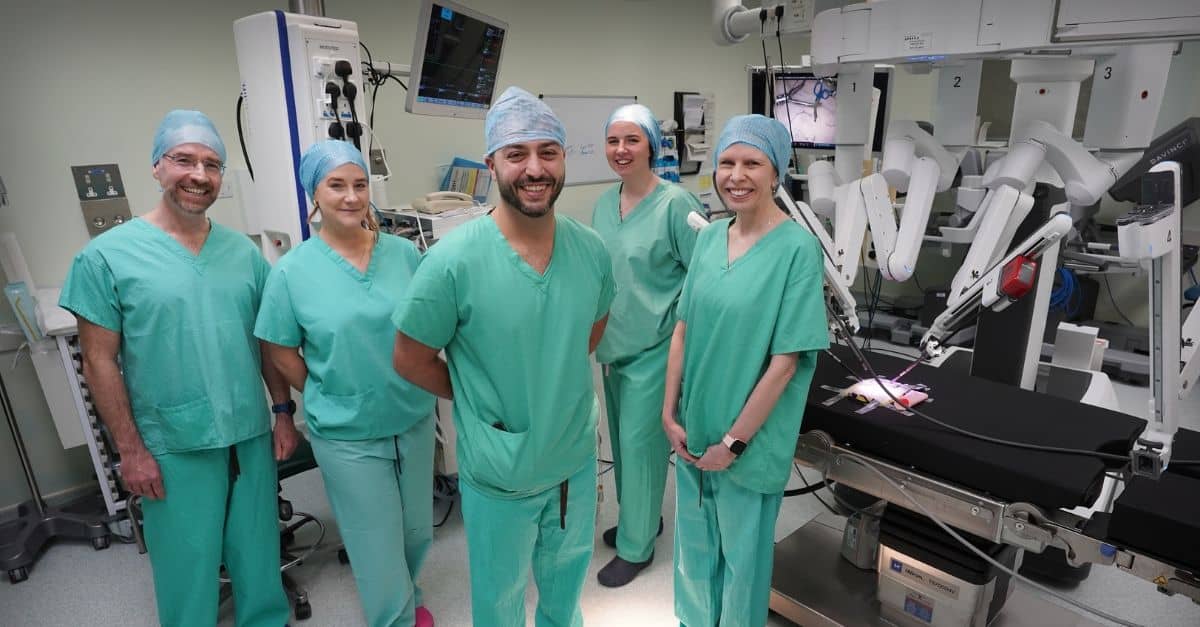
Scotland has a long history of pioneering technological and medical innovation. Home to the world-renowned University of Glasgow, the city has played a particularly important role in the development of medical ultrasound.
It is here that Nami Surgical and its groundbreaking technology were born.
From its foundations in academic research to the origins of its name, here’s the story of how Nami Surgical came to be.
Grounded in Glasgow
Founded by Dr Nico Fenu and Dr Rebecca Cleary in 2022, Nami Surgical develops miniaturised ultrasonic medical devices for use in surgical environments.
The co-founders met at the University of Glasgow, where they both completed PhDs in complementary areas of ultrasonics. Early iterations of Nami’s technology were researched and developed within the University’s world-class Centre for Medical and Industrial Ultrasonics (C-MIU).
The Centre brings together researchers, academics, industry experts, clinicians and funders to drive innovation across medical and industrial ultrasonics. Its medical research spans applications including surgery, imaging, diagnostics, wearable devices and targeted drug delivery.
It is in robotic surgery, however, that Nami aims to make its greatest impact. Alongside the opportunity to build a growing technology company and create highly skilled jobs in Scotland, Nami’s ultimate ambition is to develop devices that reach the clinic and improve surgery for patients.s.
Our Co-founder, Nico Fenu commented:
“Medical ultrasound was first demonstrated in Glasgow in the 1950s and this led to the first ultrasound device going into service in 1965.
The fact that we’re ‘homegrown’ out of the University of Glasgow and can deliver this latest advancement in the technology in our new Hillington offices (just a stones-throw away from the original Babcox and Wilcox site on Porterfield Road where Professor Ian Donald first borrowed an ultrasound metal flaw detector to test his theory) has a nice circulatory to it. This will completely innovate the global market in our industry, and being able to do that from our base in Scotland is pretty ideal.”
What’s in a name?
With the first prototypes complete and the foundations of a new company beginning to take shape, the team needed a name.
The inspiration came directly from the technology. Nami’s devices harness ultrasonic waves, and Nami is the Japanese word for “wave”.
These high-frequency sound waves are inaudible to the human ear but can deliver significant energy with great precision. Much like a tsunami, Nami’s technology harnesses the power of waves on a miniature scale to enable precise, minimally invasive surgery.
There was a practical reason behind the name, too. During the company’s earliest stages, “Nami” allowed the team to establish an identity without immediately revealing the nature of the technology before it was ready to be showcased.
What’s next for Nami?
Ultrasonic surgical devices are already well established in minimally invasive surgery. However, conventional ultrasonic instruments can be too large and rigid to take full advantage of the increasingly small and dexterous robotic platforms being developed for the next generation of surgery.
This is the challenge Nami is working to solve.
By miniaturising ultrasonic technology while maintaining its performance, Nami aims to enable surgical robotics companies to integrate advanced ultrasonic functionality into smaller, more manoeuvrable instruments.
Co-founder Dr Rebecca Cleary said:
“We are breaking down the significant barriers to using ultrasonic scalpels in robotic surgery with our high-performance, miniaturized, and dexterous ultrasonic scalpel.
With our initial round of investment secured, we are now prepared to enter into development contracts with leading surgical robotics companies. Our goal is to collaborate closely with these industry leaders to develop a new generation of disruptive ultrasonic tools that will set new standards in surgical technology. Through these partnerships, we aim to continue pushing the boundaries of what’s possible in robotic surgery, ensuring a steady pipeline of innovations that will shape the future of the field.”
To find out more about our technology, visit the dedicated page on our website.